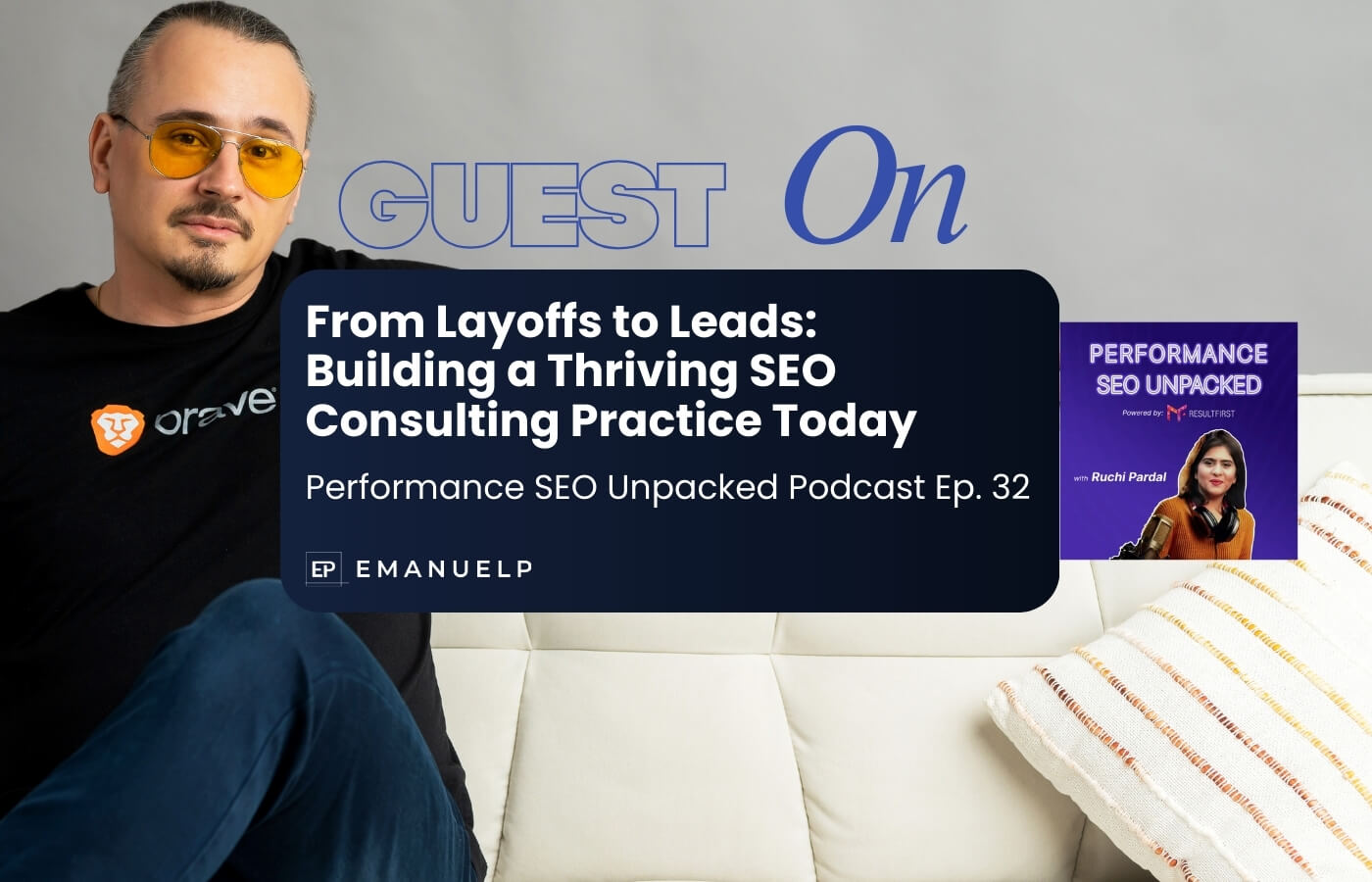
I was recently a guest on the Performance SEO Unpacked podcast, where I joined host Ruchi to discuss building a successful SEO consulting business in today’s ever-changing landscape. We covered how to turn industry challenges into opportunities, strategies for networking and client growth, and practical advice for anyone looking to thrive in the world of SEO consulting. Listen to the episode for actionable tips and real-world insights!
Apple Podcast: https://podcasts.apple.com/ar/podcast/from-layoffs-to-leads-building-a-thriving-seo/id1791135886?i=1000740556407&l=en-GB
Spotify: https://open.spotify.com/episode/0ujXhkrMOcBj04vXEsEqnP?si=KD55S4vbT2-4BWUTnHU9HA&nd=1&dlsi=b1b632d2dced49d4
Episode Transcript
[00:00:00] Ruchi: Welcome to performance SEO Unpacked the podcast that helps enterprise businesses master, SEO and get measurable results. I’m your host, Ruchi Pardal, VP of Innovation at Result First, where we’ve been delivering pay for performance SEO for over 15 years. If you are tired of SEO strategies that don’t scale, struggle to prove ROI to leadership or want to stay ahead of the latest trends, you’re in the right place.
[00:00:24] Ruchi: Each episode we break down complex SEO challenges into simple. Actionable steps designed for enterprise success. Let’s dive into today’s topic and help you unlock the full potential of enterprise SEO.
[00:00:37] Ruchi: Hey folks, welcome back to another episode of Performance SEO Unpacked, where you go beyond traffic and talk real world results.
[00:00:44] Ruchi: Today’s guest is someone who’s cracked the consulting. Emanuel has been on both sides of the SEO fence in-house agency and now solo consultant building a thriving practice in what many could call a tough market. But what’s exactly that’s exactly what we are diving in today. Why this might be the best time ever to bet on yourself as an SEO consultant and how to make that leap smartly, but not blindly.
[00:01:11] Ruchi: Emanuel, first off, thanks for being here.
[00:01:13] Emanuel: Thank you for having me. Hello. To your listeners and followers
[00:01:18] Ruchi: I’ve got to ask, we keep hearing about SEO layoffs, budgets being slashed, brands tightening up, yet you’ve built a successful consulting business in this exact climate. Why do you think now is actually a great time to start an SEO consultancy despite all the market turbulence?
[00:01:35] Emanuel: Specifically in SEO, market turbulence is a default and has been for the past 10 or 15 years. But obviously we see it’s more popular right now when we see the impact of the AIs, the LLMs have on the job market, not just in SEO, not just in digital marketing, but everywhere. There’s a I forgot from where, but there’s a proverb saying that the best time to plant it three was 20 years ago, and the next best time is right now.
[00:02:03] Emanuel: Yeah, so it’s at the right time right now. Whenever you see a threat, that also can mean an opportunity. For me, it was simple because I’ve been doing SEO and digital marketing, and I always refer to digital marketing as well, not just SEO, because all the other channels can like influence the, what we call right now, organic results.
[00:02:26] Emanuel: And we’ve seen this accelerated for the past two years. So I’ve been doing that for the past, exclusively for the past 10 years, serving the North American market. I’m from Toronto, Canada. I’ve worked, as you said, in-house small agency, very niche agency, big agency, enterprise level, and in-house digital marketing manager.
[00:02:48] Emanuel: So I had the opportunity to explore all the different ways of communicating with the market because what is different is the market and who you are addressing. And I thought, I said to myself 20 years ago, might. Have passed too fast. Now it’s the time to move along and start to build probably an agency because I like the agency concept overall, the agency framework.
[00:03:17] Emanuel: One man agency that can expand easier than than you could have before.
[00:03:23] Ruchi: Yeah. Very interesting. Yes, you’re right. Things are always evolving in, SEO and in any marketing space for that matter. I would say today we are in a place where every day is a different day and things can be completely upside down the next morning.
[00:03:41] Ruchi: You’ve obviously found your footing, but let’s rewind a little bit. That early phases are tough for everyone. When you first started consulting, what were the one to two moves you made that helped you land your very first few clients and build credibility?
[00:03:57] Emanuel: I should go back probably 20 years ago when the story started exactly around 20 years ago, and I had my own business back home.
[00:04:04] Emanuel: I’m originally from Romania. Right now I live in Toronto, Canada, and I have been for the past 10 years, but I started off having my own business and since I didn’t have the big budget I had to learn how to build a website, how to make it show up at the top of the search results, how to create a press release, how to maintain relationship with key stake stakeholders, and, other activities that now fall under the digital marketing umbrella. And they helped me acquire a set of skills that I have been successfully applied after I was done with that business and when I came to Canada, I decided to go exclusively on digital marketing, what helped me is that I already kinda had some of the projects.
[00:04:51] Emanuel: So whenever I had to have the, those initial conversations apply for a job or getting to onboard, onboard the client, I actually had something to show for my experience. I had a website, I had access to data, I explained why. And how much and all these things. So that was a plus for me.
[00:05:13] Emanuel: Something, an advantage that many probably didn’t have at that time. Now, I would say that things have changed. Were more global than we were 10 years ago, and the communication is happening even better than it was when I came. But that was my advantage. I started off by reaching out to people, putting information out there, sharing it on social platforms.
[00:05:38] Emanuel: I reach out to some people that I knew they could use some help. So I’ve volunteered to help with with my expertise as well. Also, being part of a community here also helped me generate some conversations that eventually led into some businesses that I still work with even today, some small or larger. So those were the things that helped me move the needle sooner rather than later when it comes to consulting and getting someone to pay the bills, essentially.
[00:06:11] Emanuel: Because it’s tough. It’s tough now, but I couldn’t tell you honestly that it was easier, maybe 10 years ago it was still competitive still, many things, to explore.
[00:06:25] Ruchi: So you spoke about reaching out to people, networking and talking, writing to people, helping in the community where you want to establish yourself. What are your go-to aspects for networking? If somebody’s listening to us today and they just wanna start fresh.
[00:06:45] Ruchi: What should be the one to two things that they must absolutely keep in mind.
[00:06:50] Emanuel: I always to say I’m not giving advice, but I am for sure being, being present, being online is important. Like it or not, we live in the influencers paradigm. So inevitably we need to become smaller or larger influence influencers in our space.
[00:07:13] Emanuel: And we have seen this with the rise of social, the social platform, they have accelerated exponentially during the pandemic. And now you have from, people with no particular set of skills, making millions of dollars a year from simply streaming their lives, to fortune 500 CEOs going live on different platforms.
[00:07:34] Emanuel: TikTok, Instagram, YouTube, sharing their experience, sharing information, reaching out to the customer directly, right? The line between B2B, B2C have kinda blurred a little bit, and that was beneficial for everyone, right? Because even people have seen large corporation being more transparent.
[00:07:55] Emanuel: So that’s one place to be online and to share and to find your audience and your channel. You need to experiment, but nothing will beat a, iRL connection- in real life. So what, depending on where you live, I’m fortunate enough to live in Toronto, Canada, and there’s an event every other day where you can learn stuff, first of all, from people more experienced than you.
[00:08:21] Emanuel: You can connect with the people, connect with the speakers, connect with other attendees. Connect with your organizers if you have something to share. I had speaking gigs from these type of activities, from these types of events, marketing events. They know that, hey you are SEO right?
[00:08:39] Emanuel: Let me introduce you to this person. And I got a client, you are SEO we wanna have a chat on, we want somebody to speak for 20 minutes on this topic about SEO for enterprise or some mistakes that businesses do when it comes to SEO and stuff like that. And these came from real life conversation that happened during these events.
[00:08:58] Emanuel: So especially, after the pandemic was a boom, people were hungry for in-person events and still are, and I still enjoy and go and attend them as much as I can, as much as my time allows even travel to another city, to different conferences, industry conferences. In digital marketing, there’s plenty of them.
[00:09:20] Emanuel: But in any other industry, there are many conferences and places for, anyone who wants to be better, that’s part of the deal. Essentially, be present, go there, attend all this, and engage and interact. I would highlight: the keyword here is social, in the social media as aspect of things. So being more social, being open and share the information that you have, share your experiences that will get people , to like you, to follow you to have conversation and why not generate business from that.
[00:09:55] Ruchi: Interesting social media? Absolutely. We are all seeing how it’s shaping and making new millionaires and billionaires out there with the social media influence. I wonder how would it be for people who are introverts?
[00:10:10] Ruchi: And find it hard to do the talking gigs or find it hard to go record on social media and talk. And to me, in that space, LinkedIn earlier, not today, LinkedIn is also all about videos, but it used to be an escape route where you’re still within the network and you can share your intelligence and intellect, but still not be on the screen.
[00:10:36] Ruchi: Do you think anybody who’s an introvert would still be able to pull this through, or there is something that they would be able to do, or it needs to be, it’s the game of being an extrovert and out and about and be omnipresent.
[00:10:51] Emanuel: You might think about that will be the case. But to be honest, I’m not necessarily an introvert.
[00:10:57] Emanuel: I have my introvert moments as everyone else, sometimes more, sometimes less, but I know many introverts who are actually successful in digital marketing, but beyond other in other fields as well. I believe in the fact that we as human being like to share our knowledge, like to teach others and within the right environment and within the right topic.
[00:11:24] Emanuel: I think that even some introverts can overcome Some fears that they might have, and those fears may or may not exist. I’m not saying they are, but I know. Yeah. People who are introverts, textbook introverts: ask a hundred questions so if you’re an introvert and answer yes to 200 of them that are successful and they don’t mind doing the speaking engagements, writing books, appearing on podcasts, hosting shows and webinars and so forth.
[00:11:55] Emanuel: But it all depends on the environment and on the topic as well. For me, for example, I don’t need to be an introvert to be uncomfortable speaking, let’s say about the stock market or something that I don’t necessarily have an expertise on. But usually when it comes to your expertise or even sharing your experiences, I think and I know I don’t think I’ve seen many introverts overcome this I wouldn’t call it necessarily challenge or obstacle, but overcome their initial thought.
[00:12:26] Ruchi: Interesting. Let’s talk a little bit about LinkedIn for a second here, because we both know that, it’s a bit of a circus right now. Everyone’s a personal brand, there’s a lot of performative content that’s out there, but some people are really cutting it through.
[00:12:42] Ruchi: What’s working for you when it comes to building a brand and getting the right people to notice?
[00:12:48] Emanuel: Personally, I would call LinkedIn, at least as toxic as Instagram can be. It’s if Instagram hits more on the teenage segment, I would say LinkedIn hits more on the professional segment the ones are in.
[00:13:04] Emanuel: But definitely it’s a channel I’m present on and I use it daily, this is how we interacted first, if I’m not mistaken, we got introduced, but through LinkedIn as well. Yeah. And I’ve generated business and people have reached out, or I reached out to people on LinkedIn as well. So it’s a, I would say a necessary evil, but for me personally, it’s not not my, my my channel, for example.
[00:13:29] Emanuel: So I would recommend for personal branding to each one to test and experiment your audience and where they live. You might know this in advance, if you are in, let’s say, digital marketing or SEO, you can know, okay, LinkedIn is probably the first place, but I know that SEOs o digital marketers will also go to YouTube a lot.
[00:13:49] Emanuel: So maybe YouTube is a better channel for you to start building content right now. You can even do regular posts that most successful channels are already doing it. Regular videos would be one channel where you can gather your audience around through short videos.
[00:14:08] Emanuel: You got TikTok, you got Instagram, Facebook, and we tend to forget that, I live in North America, you’re in North America. We tend to forget that the world is not just North America and there’s plenty other social channels or other ways people use the internet, so of say, right? So let’s take for example, WhatsApp. In Canada, people use WhatsApp. In US, not as much, but in the rest of the world, I would argue that it’s one of the most popular apps on the cell phone, and he has billions of daily users, right? So billions of daily users. So you have the possibility to share your work there, your already existing content and create groups there and all those things.
[00:14:54] Emanuel: If you’re a marketing professional and you don’t consider WhatsApp in your marketing activity, especially for places that are not North America, then I am. I think that you’re missing out, right? And it’s part of the Meta universe. So I would, my recommendation would be to test.
[00:15:15] Emanuel: All the channels, see what’s working. Double down on that. And as Abraham Lincoln used to say, don’t believe everything you read on the internet and don’t get influenced as much about what; follow the right people. Interact, comment. They, I love it when somebody comments on my post, and I guarantee you that even probably Bill Gates won’t be checking his comments, but even somebody bigger than you would appreciate a comment, a positive comment, and sharing your experience with that.
[00:15:48] Emanuel: Again, I would emphasize the social part in the social media.
[00:15:54] Ruchi: Yeah, the comments, the repost and the likes bring you the drilling that you need when you are on LinkedIn. Otherwise it gets so boring. Overload of content. So noisy these days. Very interestingly you bought a WhatsApp marketing here.
[00:16:12] Ruchi: I have always thought that WhatsApp marketing works best when it comes to, retail marketing, you are distributing discounts. You’re sharing a brochure or a new catalog, but I’m amazed to hear that it’s working out for you. In your B2B marketing space, just curious to learn. Do you have your own community on WhatsApp that you keep nurturing?
[00:16:37] Emanuel: I try to build my own community. I have my own agency, but also have a project called How About Some Marketing? That’s an educational component for marketers and business owners that are marketing savvy to get better at their marketing. So I did a promo there a little bit. So I’m trying to build that, a community around that as well in WhatsApp.
[00:16:56] Emanuel: It’s an integrative part of my, of my approach in marketing. But I manage, I’m part of the management of some communities that were well established, and that’s the main channel of communication. Other alternatives are Discord or Reddit. So this is a reality; it’s not it, I think it expand beyond B2B and B2C.
[00:17:20] Emanuel: There’s many companies, big companies in FinTech, for example, that actually have their main communication on Discord. But coming back to WhatsApp. I am exploring more because most of my clients are actually North America, I haven’t had the liberty to put the same kind of budget and the same kind of effort and time-wise into leveraging WhatsApp even more.
[00:17:43] Emanuel: But whoever’s running, let’s say Meta lead generation advertising have seen for the past couple of years, especially this year, more and more option on interacting with WhatsApp. Being able to run ads and message people from, or have people message you from the ads from Facebook or Instagram on WhatsApp and all these places, again, in North America might not make that much sense, especially in the US where people don’t actually use it.
[00:18:11] Emanuel: And don’t even know what’s WhatsApp in US, I think nobody knows that there’s an Android phone and not just the iPhone, but in the rest of the world. And I come from Romania, east Europe WhatsApp is very popular, has been for probably 14 years. So it has been constantly used by the population there.
[00:18:30] Emanuel: So something that will take me as an advertiser, as a business owner, know, being able to run some ads and start the conversation on WhatsApp can be instrumental in that success because once that’s happened, you have access directly to him, you can control more of the conversation and where you’re going with this.
[00:18:50] Emanuel: And there have been some ais and some automations before, but I believe that META’S AI is becoming better. We’re not accustomed to it yet. I’m not yet, but it’s there. And you’ll see in six months we’re gonna have a totally different conversation of what, six months to a year. This my prediction, totally different conversation on what advertising on WhatsApp actually is, and how ai, Meta AI plays a role in all these things.
[00:19:21] Ruchi: Very interesting. Let me ask you a big question that has been on my mind so far. A lot of SEOs know how to do great work, but consulting is a different beast. It’s not just about delivering reports. How do you structure your engagement to show strategic value?
[00:19:39] Ruchi: So clients see you as a partner, not just as a deliverable team.
[00:19:44] Emanuel: That’s a great question. For me, it was always about education and establishing trust at the beginning, even when I was in, in the agency environment or in-house where I had to work with the stakeholders, with the business owners, right?
[00:19:57] Emanuel: I was the main guy responsible. Here’s some money. Make us more money with that money, essentially. That’s the game of advertising. Is establishing a great relationship at the beginning and in order to be successful, I believe in the education first. Why are we doing that? What’s the thought process behind it?
[00:20:17] Emanuel: Why should we invest more in this rather than that? And SEO probably is one of the worst in a sense of clients and people who are paying understand exactly what SEO is. Because even right now, in 2025, many, business owners that have paid for SEO or paid ads don’t actually understand the difference, and then they have paid, if not millions of dollars for the past 10 years, but don’t understand the difference from organic and paid and what an SEO consultant do and what what are the, its KPIs in order to be successful?
[00:20:56] Emanuel: This conversation usually happens at the beginning with me. Of course, I tell people even if they’re in a larger organization or that needs to navigate more politics. So let’s say, or they have different internal regulations that may prevent to be as, to be, to pivot or to move as fast as one might need in order to be successful.
[00:21:19] Emanuel: But once I develop this relationship, and that’s through education, I tend to have those relationships longer term. I tend to have the clients being more interested in the work and learn to understand the organic part of the traffic that’s bringing them business.
[00:21:42] Emanuel: And it was, I won’t say it was pretty boring between quotation marks up until one or two years ago when we said search engines actually was just Google. Who cared about Bing? Just kidding. But not kidding. Right now it’s, the conversation happens more more broad. It’s not just Google and although Google is still the dominant force. GPT, Perplexity, Gemini, Claude, and all other smaller ones, Grok are getting more and more eyeballs. People use them more. That’s why I said Metas AI is will be an important factor. You can actually use Metas AI in the conversation. So once people will start realizing.
[00:22:28] Emanuel: One might think I work for Meta. No, I don’t. But once people will realize that they can perform more, probably two of the tasks that they’ve been doing outside of the Meta, go to Google and search for something and then go to charge GPT and search for something else. Once they realize that they can do it in that environment, then things will change exponentially.
[00:22:49] Emanuel: We see more and more of that segment getting, sending traffic to the websites. But still Google is the dominant force. It’s getting better. If one year, one year ago, around this time, I didn’t use Gemini, I couldn’t use it. It wasn’t adaptable to my workflow. Right now, I’ve been using it more and more.
[00:23:08] Emanuel: I wouldn’t say I use it more than Chat GPT, but I’ve been using it more and more for the past couple of months, so expect that and, be vigilant and if you’re a professional, be open-minded to the changes that are happening. And be transparent and communicate with your clients. If you are still like going, looking at the same report, just keyword positioning and rankings and traffic, that’s good, right?
[00:23:39] Emanuel: That’s a part of the work and it’s still important, but we all seen what, one month ago when Google slashed everything, page two is not reported in any tool anymore, right? So things will change. So if you don’t have that initial conversation at the beginning, develop that relationship based on trust and transparency.
[00:23:58] Emanuel: Then it’s it’s unlikely to have a long-term collaboration. And that has worked in my favor because even when things went south, not necessarily because of me or because someone else; an algorithm change or a business decision that probably remove something or added something else and created more friction because you had that relationship because you had the transparency all this time you were able to renew and said, you know what?
[00:24:27] Emanuel: We’re in this together. Let’s renew and we’ll figure it out in the next six months, what we’ll do as opposed to go somewhere else. So this has worked for me. It’s the way I am and this prompt me to build the organization that kinda reflects my values and my approach. Transparency being one of them.
[00:24:47] Ruchi: That’s awesome here because I think that’s one of the key goals of communication anywhere and whatever situation set up you are in transparency and of communicating effectively is super important. One thing I know that you are very good at is maintaining relationships, but there’s a difference between having a network and actually converting it into paid consulting work.
[00:25:12] Ruchi: What are your favorite strategies for building relationships that lead to business, not just dms, likes or shout out?
[00:25:19] Emanuel: Probably many things and it’s sometimes it’s hard to explain something that I’ve probably been doing it naturally, and that’s probably something that I was brought up to do. But it goes beyond, as you said, the likes, the shares.
[00:25:34] Emanuel: I recently had somebody from my community that, reach out to me to do, go to market strategy and might even hire me further along to execute on that strategy that it’s been in my pipeline for eight years.
[00:25:50] Ruchi: Wow.
[00:25:50] Emanuel: So for eight years. So yeah, it was one of the first conversations that I had when I came to Canada as a consultant, and it was a fairly larger organization and they were like, okay, we know this. We know we need that. Will reach out at the right time and through all that time I always continued a relationship. Obviously holidays and any other major event. But sometimes even when you came across a research or an article in his field or in his line of work that can be beneficial, that information can be beneficial.
[00:26:26] Emanuel: Just sharing this hey, you know what? I was reading this, or this is game. I was watching this podcast or, and this conversation was happening. I thought you’ll be interested in this. Dropping a line email is always more personal than a LinkedIn message or a text message, so in some cases as well.
[00:26:44] Emanuel: So maintaining this and having that business, that person and that business is best interest in mind as if it were your client can help and can potentially translate into business. Not necessarily now, but a couple of months from now. Many customers, we know that they’re locked in contracts for one year, sometime even more.
[00:27:10] Emanuel: And larger an organization is, it’s more unlikely to switch anytime soon from a provider even if there’s a painful experience for everyone. And I’ve been in some meetings where it was a pain experience with the client manager from the agency and also from the company’s representatives and from, for all the stakeholders.
[00:27:32] Emanuel: They were so accustomed to and switching creates such a painful process that people just leave it as is. But I think communication and education, I said, and being constant active and not forgetting about them can help. And I just gave you that, that example that I, I wasn’t completely surprised, but I was, they reached out. Hey, Emanuel, you know what? Now is the right time. Now we have everything that we need. I couldn’t think of a better person to help us do this than you. Let’s have a conversation.
[00:28:06] Ruchi: Interesting. Eight years is quite a lot of nurturing and relationship building and maintenance.
[00:28:13] Ruchi: Congratulations on that.
[00:28:14] Ruchi: This transition isn’t for everyone. What’s one trap or mindset shift people must make when moving from in-house SEO to running their own consultancy?
[00:28:28] Emanuel: I wish I knew the answer, the real answer to that question, but I would think. That being more confident in your skills and you most likely are already, have all the skills that need, you need to be successful in this business. And I’m having this conversation with myself every day. Essentially, the imposter syndrome is present today as it was 10 years ago as well, and I’m pretty sure it won’t go away.
[00:28:55] Emanuel: I still get nervous, I still prepare intensively. Even right now I’m still thinking, what if I say something stupid? Why did I say something that’s irrelevant? What if I forget about something else? That’s still happening there. And it’s happening not just in digital marketing, in SEO O, but in any other industry as well.
[00:29:13] Emanuel: What’s different in SOO and digital marketing, it’s that it’s more complex and things change and you need to adapt fast. So I might tell you something right now, and by the time this podcast gets published, it’ll be completely obsolete, irrelevant, or might even damage if you implement what I’m recommending.
[00:29:31] Emanuel: So I would say be a little bit more confident and start building up that confidence by getting small successes and try to appreciate them and enjoy them. I’m a, you asked me earlier about introverts, not just introverts, but even myself, i’m an immigrant in Canada, so I was always under the impression that people don’t understand me and I was nervous to present, let’s say a report.
[00:29:56] Emanuel: Even when the results were great, actually I was nervous we increased, we doubled the traffic in the past six months, and we see 10% to 20% more form submissions and 10% more conversions, stuff like that. And that’s a positive sign, especially when you work with the larger organization.
[00:30:12] Emanuel: Nevertheless, I was still nervous. I was still thinking, oh my God it is something bad. And I learned to overcome this because first of all, you have to, yeah. And people tend to get a sense of what you, who you are and what you are and where your limitations are. That’s why I believe in the educational component that I talked to at the beginning, and put yourself out there that it needs to be a little bit of pressure and it needs to be a little bit of pain.
[00:30:41] Emanuel: And you learn from mistakes. Not all the consultant calls that you have, all the prospecting will translate into clients. Sometime, most of the time they’ll go with somebody else that’s probably less capable than you are, but somehow seem more confident. There’s always somebody who’s cheaper, faster, and better than you.
[00:31:05] Emanuel: And yeah, all these three things do exist. We need to understand, especially right now in the AI paradigm, especially right now, where, when the world is so connected and you can easily reach out to any corner of the world for a service, but I believe confidence and build your personality and your character as the way that you know represents you and understand what’s, what’s working for you and what’s not? Who’s your ideal customer and who’s not? Being able to say no can mean a lot actually. And this, I still struggle with saying no. Yeah. Refusing essentially money refusing business. But that will take you, take away time, energy that can help you build, work on something that you really enjoy and do something else.
[00:31:54] Ruchi: The art of saying no for your own good actually brings in a long term advantages.
[00:32:01] Emanuel: Still working on that. Yeah. And saying no to sugar first. That’s the biggest, I, I struggle with.
[00:32:07] Ruchi: That’s great. Emanuel. This was packed with real, raw and practical advice. Thank you so much. You, seriously, I appreciate how open you were with your journey.
[00:32:16] Ruchi: You touched upon so many different aspects and not just for North America. You picked it up at a global level for those who are listening and who are thinking of making the leap or are already freelancing and want to level up. I hope you know this gives you both clarity and motivation. You can find a Emanuel on LinkedIn, and if you’ve enjoyed the episode, don’t forget to hit subscribe.
[00:32:39] Ruchi: Leave a rating and share it with someone who needs to hear this today. Catch you on the next one.
[00:32:45] Emanuel: Bye everyone. Thank you for having me.
[00:32:48] Ruchi: Thank you for listening to performance, SEO unpacked. I hope today’s episode gave you practical insights to help scale your SEO and drive results. If you enjoyed the show, be sure to subscribe so you never miss an episode.
[00:32:59] Ruchi: And if you found value, share it with your team or a fellow marketer. For more tips, tools and strategies, visit resolvers.com/unpacked and connect with me on LinkedIn for the latest episode on enterprise SEO. Thanks for tuning in. See you next time on Performance SEO Unpacked.