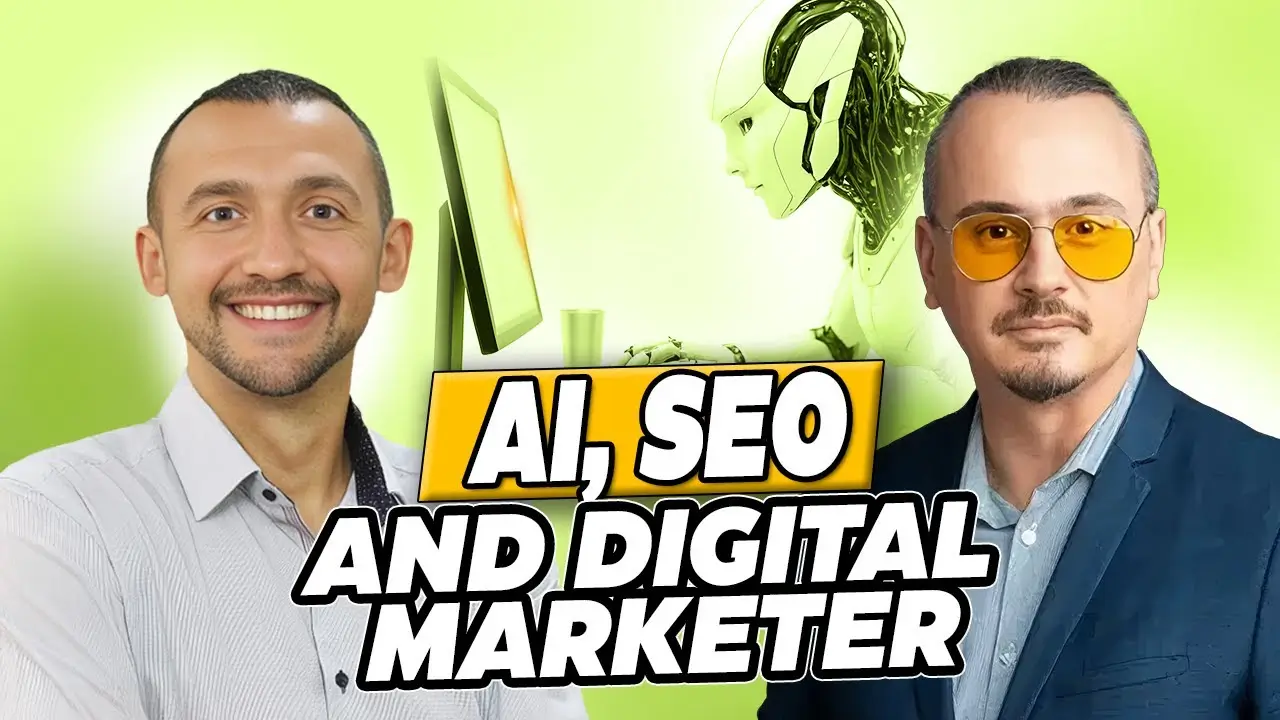
I don’t remember for how many times I’ve been a guest on Anatolii’s show. But I enjoy it each time. And we’re talking about the same thing, yet due to the nature of digital marketing, it always feels like it’s a different topic altogether.
Anatolii (Host):
Hello good people, welcome to our show. Hello bad people, welcome to our show. Today I’m so excited to discuss more about SEO, digital marketing and, of course, AI—because today we can’t ignore this tool, and if you use it smart, you can get great results. I’m so excited to discuss all these topics with Emanuel. How are you?
Emanuel (Guest):
Hey Anatolii, nice to be back again. I’m excited. How about yourself?
Anatolii:
Yeah, doing great. Looking forward to more. I know I always have good engagement with all your episodes. You spoke four times, it’s the fifth time on my podcast—absolutely a record. I love it because we grow our audience, and more people can listen to this podcast, learn from us, on LinkedIn and many other social media. I’m so excited to learn more about what’s going on in this world. You live in Canada, so probably you have some projects in Canada, and you’re from Romania originally. So let’s learn more about international SEO. Can you tell us more about yourself?
Emanuel:
First of all, it’s a pleasure and privilege to be a guest on your podcast for the fifth time. What can anybody say but thank you again—thank you for everyone who engages and reaches out from previous episodes. Thank you to everyone who’s watching us and keep doing the great job that you’re doing, Anatolii, because let me tell you—if nobody told you before, let me tell you that you’re making a difference. We’re in digital marketing, SEO, AI, and if there’s something constant, it’s that we can’t stop learning. It’s not that we don’t want to, but we can’t stop learning—otherwise, we’ll be obsolete. How do we do that? By reading articles, watching podcasts, subscribing to YouTube channels such as yours. Thank you so much for all the work you’ve been doing for the past several years and for having me as a guest.
My name is Emanuel. I was born in Romania, lived there for most of my life, but almost 10 years ago, I came to Toronto, Canada, and I’ve dedicated myself to full-time digital marketing since I had previous experience from home. This is how I learned SEO—as many others, by having my own business and trying to do SEO and digital marketing because, hey, it might be free, it might bring free traffic. Spoiler alert: it’s never like that. Nevertheless, I fell in love with the craft, started learning, applying, and got a job, building a career around digital marketing. My background is in SEO—traditionally known as search engine optimization—but I believe the term “search experience optimization” is more relevant today, in the AI paradigm we live in. At the end of the day, it’s about experience. I like to work with clients, consult, make a positive difference, drive more revenue. Sometimes I expand beyond SEO if I sense another channel can bring more relevant business, so that’s why I consider myself a digital marketer, but SEO is my bread and butter.
Anatolii:
Awesome, amazing! You mentioned resources where we can learn—YouTube videos, blog posts, podcasts. I love all of them, but I prefer reading. I love reading more—books and blog posts. Sometimes I listen to audio podcasts, especially when training or riding. My main format is reading. What I often notice is that new professionals learn a lot and do almost nothing. For me, that doesn’t work—you need to get your hands dirty. If you learn a lot, it doesn’t mean you get results. But if you test, if you try everything you learned, you can get results. Can you tell from your experience how to do it right, especially today in the AI era? There is so much information online—how to figure out which is good and how to test it?
Emanuel:
Excellent question—you caught me off guard. But, as with everything else, actually doing, getting hands dirty, will make the difference. Of course, you can read a lot, but don’t take anything you read in digital marketing for granted—especially from Google. They say one thing but do another. By doing, for sure—reading, podcasts, watching, attending conferences, engaging in masterminds, groups on Slack, Facebook, and so on—can only add to your knowledge and make you better: a better consultant, a better digital marketer, a better SEO person.
But actually doing is how you learn. If we’re talking strictly about SEO, you need to take a project from start, do your own research—keywords, competitors, market, industry—see what shows up in the top results and why. Then, get into the technical side. I’m not saying you need to be a developer, but you need to know how to set up a tag, implement code, work with APIs, Search Console, Google Analytics 4—which is not as easy to manipulate as prior versions. I often feel frustrated with Google Analytics 4, and I’m sure I’m not the only one. You need to have a data analyst mindset looking at these things. You can read about them while working in them—but get your hands dirty to learn. In six months working on a project, you’ll learn more than three or four years of just reading articles. Employers want real life experience. You’ll be able to show exactly what you did, and that makes it easier to get hired than not really knowing what you’re talking about—which is common in our industry.
Anatolii:
And is it a good idea to join college for marketing education? Our industry changes really fast. I never got marketing education. My first degree was finance, I worked in that niche for a long time. Built some offline businesses, not bad, but the world crisis changed everything and I switched to online. That was my best decision. I learned marketing myself, tried to create something online, but many SEO experts couldn’t bring results. I found you need to learn yourself—even when cooperating with clients, if they have poor skills, I tell them: just learn it. You need to understand what you want to delegate. Once you understand the basics, you can cooperate with experts and get results. So, when I started learning, I found you don’t need a marketing degree. You need to get your hands dirty, just do things. After some recognition, a few universities invited us to meet their students—poor skills, nothing special, just generic. Probably marketing is not the best place for college. Medicine, health, maybe. What do you think?
Emanuel:
Hopefully medicine—yes, they should go to school. I’d love my doctor to have gone to med school. I agree completely. There are some things I learned in university—a business administration bachelor—and I still remember some database courses, fundamentals I use today: working with CRMs, custom integrations, APIs, databases. Those things can help, but right now in 2025, especially in the AI paradigm, fundamentals are more important than ever. A smart digital marketer or newcomer can get their hands dirty and in six months get results that set up a successful career.
Anatolii:
We got a comment from Craig Campbell, a well-known SEO expert. I learned a lot from him. Last time I learned he explained a lot about black hat—I don’t know what he does today. You mentioned manipulation. Can you tell from your perspective about it? Today, a lot of guides from known experts explain how to create content for AI search. Things change fast—even Google changes algorithm, but not dramatically. In AI, studies show 40–60% of searches change in one month, 70% change in two or three months in Gemini. So if you adapt to a new guide to manipulate algorithms, it can change quickly. What do you think?
Emanuel:
So much to unpack! I’ll take it one by one. Regarding changes, we’ve worked in SEO and with Google for a while, and we’re all accustomed to changes. Many businesses have been hit by algorithm updates that wiped them out—or made millionaires. Right now, changes are accelerating. I’m not sure if it’s easier for us who’ve been in the game, or more confusing for newcomers. What we’ve done hasn’t changed—the pace has. The client needs a hole; they don’t need a hammer or a nail. What we’re doing: helping businesses get more business. Today, it’s SEO; tomorrow, it might be social or paid ads. That’s my job—to help them make more money. Changes are happening—keep up.
Does your website still need to be fast? On a good server? Optimized page titles and meta descriptions? Internal linking structure with descriptive anchors? No blocking scripts, no technical errors? Yes! Even in 2025, many websites lack basic on-page SEO. We still need to work on those. Yes, we should pay attention to the AI—the dashboards, the traffic reports—but fundamentals are as important as ever.
Anatolii:
I prefer reading books about marketing and human psychology over digital marketing. If you learn about marketing, you can adapt to anything. Marketers on TV and radio adapted to digital. Specialists can adapt. Speed matters, whatever channel you use—if you create high-quality content, it helps anywhere: Google, YouTube, branding. Backlinks and authority are important. Not just links for weight, but links that bring traffic and awareness. Think of how every channel can help—not just SEO, but all areas. In 2025, I recommend businesses spend more time on Reddit. That’s where audiences engage, and sources cited in LLMs are often from Reddit. I tell people: spend 20 minutes a day on Reddit, answer questions, mention your brand (carefully—Reddit can boost or ruin you). It’s cited in Google and all LLMs—so it’s still SEO, because it’s about search experience. Thoughts?
Emanuel:
It’s true—Reddit is increasingly important. People go straight to Reddit for answers. Google noticed and started featuring Reddit results. Brave, the browser and ecosystem, also featured Reddit results before Google did. Brave has its own crypto token, a reward system, ecosystem, and its own search engine. I find it fascinating—they started featuring Reddit results before Google. It’s an important trend.
Anatolii:
Should we create content specifically for AI? Some recommend writing like AI would, but I haven’t found such content in AI search. AI search doesn’t drive much traffic—mentions and links, but people don’t always click. Sometimes links are just for trust, like the dozens on Wikipedia. If content is created solely for trust, is it worthwhile? Shouldn’t it give a reason to click? For me, the best strategy is to find which content AI references and create about those topics. Thoughts?
Emanuel:
Short answer: it’s a terrible idea. That’s probably one of the biggest fallacies in digital marketing today. As of September 2, 2025, less than 1% of worldwide web traffic comes from LLMs. It’s still irrelevant. Focus on what the client/prospect needs—it’s about their goals (the “hole”), not just the latest tool. Writing for AI as AI would might bring short-term results, but where will you be six months or three years from now? It’s naive to think only Google, OpenAI, or a handful of platforms will matter. These models cost millions daily, and sentiment is starting to shift—people realize tools aren’t magic solutions. Many pay monthly for tools they don’t use. Short answer: writing like AI is a terrible idea. Always speak to users, use tools as helpers, but focus on customer experience.
Anatolii:
I don’t know about the future; I’ve failed at forecasting many times. For me, adapting is better. I use technology to help clients and projects. Forecasting isn’t my strength. Unrealistic to think anybody knows.
Emanuel:
Exactly. If anyone claims to know the future, they’re unrealistic.
Anatolii:
Let’s talk about newcomers. When I started my project, I struggled due to lack of experience. In time, we got a lot of traffic—learning bit by bit, analyzing, improving content, acquiring backlinks, and got great results. Today, newcomers face tough competition and need to compete with big brands in every niche. You need to do something differently, build brand awareness, invest time and money. Imagine starting a new project today—what would you do first, second, third? Your checklist?
Emanuel:
A tough question, not easy to discuss with clients. The investment needed—not just money, but time, commitment, and knowledge—is what it takes to compete nowadays. Prices for paid ads, services, are high, competition is fierce even for traditional trades like plumbing or roofing. Budgets today don’t go as far as even three or four years ago. Now you often need big investments. Having a skilled consultant matters. If I started a new project today, with no experience, I’d focus on a single channel—probably Reddit. Build a website, get local SEO in order, Google Business Profile, major profiles, but to promote, focus on Reddit and LinkedIn for awareness and thought leadership. People seek experts—if I’m not an expert, I can help make the owner the expert and build thought leadership for results. That’s my approach for limited budgets and little experience: focus on one thing while building skills.
Also, contrary to some beliefs, the AI paradigm makes it more important to know development skills—HTML, CSS, JavaScript. AI can create you a landing page, but there can be many issues (not just security). Knowing server setup, configurations, security settings helps. I’d work on fundamentals and focus on a single channel.
Anatolii:
Great answer! But we have a short format, so let’s move to my final question—when I invited you to the podcast, you said that only jack of all trades will survive. I want to discuss that. For me, focusing on one niche is important, especially with limited resources. Some specialists excel by focusing on one thing—email, LinkedIn, YouTube, TikTok. Their engagement and sales are huge by focusing. Jack of all trades, in digital marketing, means understanding everything and leading a team. Compared my speed with my content manager on WordPress—I lost six times; she’s much faster and the content is better. Same with other roles. Specialists do their job better. Thoughts on jack of all trades surviving AI search?
Emanuel:
Specializing brings success, and I completely agree. Content writers, link builders, even industry niches—being specialized matters. But in the next five years, operating in the AI paradigm, we’ll see agentic AI performing more automated tasks—better than before. Companies seek profit, which often means replacing staff with automation. So, “jack of all trades” is less about doing everything and more about knowing and being aware of everything. Hiring a developer—there are many ways to build a platform, but thinking ahead and understanding long-term impact matters.
If I want a site that lasts five years, I won’t just have an LLM create it—I’ll want something custom, secure, with a solid database. For emails, chatbots, automations, expert specialists will build those. In five years, most of these will be automated, but not overnight. For link builders—most outreach tasks can be prompted as an employer. If that’s all you do, you risk automation. Maybe “jack of all trades” isn’t the best phrase—perhaps T-shaped marketer is better (Rand Fishkin popularized this): breadth in digital marketing (email, website, SEO, paid ads, social media, research, analytics), but deep expertise in one thing. Will you succeed without knowing email automations or server setup? Maybe not. Most of us delegate, but knowing the process matters. In the future, those will become prompts, and being relevant means knowing multiple channels.
Anatolii:
Awesome. Emanuel, tell about your strengths—your preferred client types, projects you focus on, how listeners can follow and reach out to you?
Emanuel:
All my clients/projects are important—they’re all my babies. Success comes from engaged clients—those who meet, talk, debate, and collaborate. Not just monthly compensation, but real engagement. I’m not a technical expert in every client’s field, but I identify opportunities and—with the client’s expertise—help fill gaps and seize results. AI can help, but shouldn’t be relied on blindly—un-edited results can mislead or even bring legal or financial issues.
Anatolii:
I love AI. I use a lot of AI, but prompts and editing are vital. I work with writers and experts, and after AI, I prefer to hire real experts instead of copywriters. Doesn’t matter if they use AI or not—I want quality. Experts drive AI in the right direction and ask the right questions. If you ask me to write about weight loss, I can’t give great value. But for SEO or digital marketing, I have the expertise. It’s the same in any niche: you can use AI tools, but you need expertise to guide and edit the content. I’m looking for expert content managers for AI tools, because AI is just a machine—it needs a skilled driver. Emanuel, big pleasure to learn from you. Welcome back any time to share more valuable insights. Hopefully we can do more episodes before AI replaces us, if AI influencers ever host this podcast. For now, we still share valuable insights as humans. Everybody, follow Emanuel on social media, reach out to him—and if you want to cooperate, let him know you found him on this podcast. See you!